You can change habitat loss in your yard and community

nwfExcerpted from the National Wildlife Federation’s “Attracting Birds, Butterflies and Other Backyard Wildlife” by David Mizejewski

Imagine a child growing up without having the opportunity to watch a tadpole changing into a frog, to smell a wildflower, or to wade in a clear stream. As we enter the 21st century, natural places and the wildlife species that inhabit them face ever-increasing pressure from human activity. Today, there are fewer places on Earth that have not been affected by the way and the rate at which we build and maintain our homes, farms and cities. As a result, natural habitat is disappearing at an alarming rate, and habitat loss is the No. 1 threat to wildlife today.

Wildlife species and the natural areas they need to survive are important and should be protected and restored. Imagine life without the song of birds and the chirping of crickets, the beauty of a windswept prairie, or the cool serenity of a green woodland. Without wild areas, humanity, as well as wildlife, suffers.

But there is hope. You can surround yourself with beautiful native plants that will attract wildlife and allow you to observe an amazing array of wildlife every day. In doing so, you will be doing your part to restore the ecology of the land on which you live.

Restoring a Vanishing Habitat

As the human population grows, it competes with wildlife for resources and space. Our agricultural and land development practices increasingly alter the landscape in ways that render it barren for wildlife.

However, you can change some of these conditions by creating a wildlife habitat in your own yard and throughout your community. By planting native plants — plants that would grow in the area naturally — and taking a few other steps, you can restore the components of habitat and invite wildlife back to the land it once occupied.

Creating a wildlife habitat is more than just planting a pretty garden. It’s actually restoring one small piece of the ecosystem. Before starting out to create a natural habitat, it is important to realize that all plant and animal species have an impact on and are affected by other living organisms and the environment around them. Science refers to this interaction as an ecosystem. Healthy ecosystems are balanced. Apply this principle to your garden and landscape plans, and you’ll create a balanced, self-sustaining mini-ecosystem that supports birds, butterflies, and a variety of wildlife species.

Learn more about the book “Attracting Birds, Butterflies and Other Backyard Wildlife” at the National Wildlife Federation’s Web site.
Posted in Alarm signals | Tagged , | 1 Comment

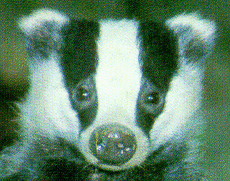
Orphan badgers have a chance to life

badger

Photo Source: Badgerland

At least five times a year, Pauline Kidner receives a most unusual package: an orphaned badger cub. This time, it’s little Chestnut, an infant of about five or six weeks old. Somewhat battered and worse for the wear, Chestnut desperately needs Pauline’s expert first aid. It’s a tough world out there for badgers. People shoot them. Predators maul them. So it’s lucky that there are individuals like Pauline who are willing and able to reverse the damage. Long-time residents of Pauline’s native England, badgers are highlysocial animals that live in defined family territories. View the video on First Science

Pauline Kidner, one of the UK’s more famous badger rescuers, runs Secret World – a farm environment (based in rural Somerset), that homes and cares for sick and injured animals, returning them to the wild wherever possible.

Pauline’s Books
Glade’s Journey- Stories from an Animal Hospital
“Life with Bluebell” and Other Stories from an Animal Orphanage

Contact
Pauline Kidner
Secret World, New Road Farm, East Huntspill, Near Highbridge, Somerset, TA9 3PZ

Phone 01278 – 783 250

Email pauline@secretworld.org

Posted in Alarm signals | Tagged , | Leave a comment

Thumbs up for PETA

PETA fired off a letter to the U.S. Department of Agriculture (USDA) demanding that it begin protecting animals raised for the bloody fur trade after PETA investigators on a fur farm in Midland, Michigan, saw chinchillas who were being electrocuted, causing painful seizures to the animals’ hearts, and having their necks snapped while completely conscious. Animals killed for their skins—including chinchillas, foxes, minks, and raccoons—currently receive no federal protection from the kinds of abuses that our investigators witnessed.

Read PETA’s letter to the USDA. (pdf format)

April 11, 2007: Update: Court Rules in PETA’s Favor
A federal court has thrown out a lawsuit that was filed to stop PETA from showing video footage from this investigation. The lawsuit claimed that the owners of the fur farm were harmed by the investigation, but the court ruled in PETA’s favor on every claim and dismissed the entire case.

U.S. District Court Judge David M. Lawson stated that PETA “has a right to object publicly” to the raising and electrocution of animals for their fur and that “[t]he methods and practices of raising and destroying animals, especially for commercial purposes, has been recognized as a matter of public concern.” He compared PETA’s use of undercover investigations to that of major TV networks: “Undercover investigations are one of the main ways our criminal justice system operates. In addition, television shows like PrimeTime Live and Dateline often conduct undercover investigations to reveal improper, unethical, or criminal behavior.” The court concluded that PETA’s publication of its undercover video footage on its Web site was the “truthful publication of and accurate representations of” the furriers’ actions.

Tagged | 1 Comment

Kill’em all

Comfortably seated in your chair, you turn on the computer, enter a hunting field, adjust your mouse on a deer which is grazing quietly and click. The deer falls on the ground. After a few days, a courier rings the door bell, bringing the deer’s corpse, sent by the owner of the virtual hunting land. These animals do exist, having implanted a cip connected to an online stage, therefore, when the hunter presses “the trigger”, the cip emits an intense electric signal which kills the animal. This is the essence of the “online hunting”, business started by a Texan – John Underwood, who did not know how to make good use of his animal populated 133 hectares field.

The investment was of almost 20.000 dollars and a “season ticket” worth thousands of dollars yearly. Good bargain! “This technology offers the hunting possibility for the persons with handicaps or soldiers in missions abroad. Also, the participants are protected for the possible attacks of the animals and safe from the possibility of unintended shooting of another hunter, aspects which have to be first considered before the ethical ones” declares Underwood when the Animals Protection Association revolted against these practices.

After Underwood, probably because the business was so successful, other Americans started similar projects. Last year, another Texan, John Lockwood, launched a site that permits ”users” to kill antelopes, wild boars and other animals which were staying on his property of 80 hectares in San Antonio. Of course, the obtained trophies were sent home immediately after a tax had been paid. Problems may occur, too. Thus, during an online hunt meeting, a user found online at 70 km distance, shut a wild boar while he was grazing at Lockwood’s ranch. But, the wild boar was just injured and the owner of the ranch had to go into the woods to find and kill the wounded animal.

Like I was saying before, this practice started a lot of contradictions within the governmental institutions of USA. The technology, which permits users to go online and hunt wild animals, alarms the hunting associations and authorities, because of the possible implications. This method presumes the using of a robotic platform, a webcam and an electronic controlled gun. Many states for USA, already interdicted by law these practices, called “online massacre over money” by the Animals Protection Association.

Even the passionate hunters argue over the online hunting, because every person comfortable seated in front of a computer can shoot with accuracy the animals that are practically in semi captivity, without a need to walk many kilometers through forests, plains or swamps.

“We consider that sick ideas spread fast and we wish that online hunting to be interdicted in USA”, declared a representative of the Animal Protection Association. Groups which see hunting as a sport, like The Safari International Club and National Rifle Association, oppose, also, to hunting remote systems. “This sport is not for lazy people”, says a hunter from Illinois. In present, in many state of USA, using online hunting systems implies a contravention and it is punished with jail till 6 months and a fee of 1.500 dollars. Persons who provide software and hunting services through remote equipment can be convicted a year in jail and the payment of a fee for 2.500 dollars. According to these sources from the IT&C market, this type of business orientate to the Eastern Europe, where the gaps in legislation permit the development of this kind of business.

Posted in Alarm signals | Tagged | 11 Comments

In Google we trust !?

Google.org engages Google’s talent, technology and resources to address some of the globe’s most difficult challenges. We’re currently exploring the best approaches and solutions for significant, positive impact in the areas of:

  • Global Development: develop scalable, sustainable solutions to poverty by focusing on economic growth in the private sector and improving access to information and services for the poor.
  • Global Public Health: enable the world to better predict, prevent and eradicate communicable diseases through better access to and use of information.
  • Climate Change: mitigate the effect of climate change on the poor by reducing greenhouse gas emissions, improving energy efficiency, and supporting clean energy sources.

The Google Grants program supports organizations sharing our philosophy of community service to help the world in areas such as science and technology, education, global public health, the environment, youth advocacy, and the arts.

Designed for 501(c)(3) non-profit organizations, Google Grants is a unique in-kind advertising program. It harnesses the power of our flagship advertising product, Google AdWords, to non-profits seeking to inform and engage their constituents online. Google Grants has awarded AdWords advertising to hundreds of non-profit groups whose missions range from animal welfare to literacy, from supporting homeless children to promoting HIV education.

According to its headmasters Sergey Brin & Larry Page… “We hope that someday this institution will eclipse Google itself in overall world impact by ambitiously applying innovation and significant resources to the largest of the world’s problems.” Taking into consideration that this is another one of Google’s projects, it should be enough to have a huge promotion boost and results. We shall see.

Posted in In The Field | Leave a comment

Endangered elephants

family

A forest elephant family photographed in the Congo.

Forest elephants are the lesser-known cousins of the savannah elephant, and are restricted to the dense jungles of the Congo Basin in Central Africa. A recent study by the Wildlife Conservation Society shows that the construction of roads in Central Africa directly linked to a decline of forest elephants by giving access into remote areas by poachers. The Wildlife Conservation Society is working to safeguard elephant populations by bolstering enforcement in protected areas and parks and also calling for better patrolling along roads to reduce poaching.

Jeanna Bryner, LiveScience

Roads that now penetrate into the heart of Africa’s jungles are making it easier for ivory poachers to kill large numbers of forest elephants, a new study finds.

The elephants that do survive are being forced to turn tail and retreat to protected parks and spots not yet encroached upon by humans.

“Unmanaged roads are highways of death for forest elephants,” said lead author Stephen Blake, a biologist at the Wildlife Conservation Society in New York.

The study, detailed in the current issue of the journal PLoS Biology, reveals that along roadways elephant numbers plummeted, which the authors say is largely due to heavy ivory poaching in these areas. There is a large, international black-market trade in the ivory from elephants’ tusks.

“It is not the physical effect of the road that is the issue—forest elephants actually like roadside vegetation—rather it is the fact that unmanaged roads bring people, with their guns and ammunition,” Blake said.

This study is the first major scientific survey of the forest elephants since 1989, when scientists estimated a population of 172,000 forest elephants in the Congo Basin.

Between 1970 and 1989, half of Africa’s elephants (or about 700,000 individuals) were killed, mostly for their ivory tusks. The extreme decline spurred the Convention on the International Trade of Endangered Species of Wild Flora and Fauna (CITES) to list African elephants and thus ban the international ivory trade. Currently, debate over repealing or modifying the ban has been the focus of CITES conferences. The ban was effective at protecting elephants at first, but it is largely unenforced now because governments have withdrawn funding for it.

The authors of the present study suggest that an informed debate and resolution on the matter relies fundamentally on a clear understanding of the size and trends in elephant populations along with the rates of illegal killing for ivory across Africa.

“We have shown that even with a near-universal ban of the trade in ivory in place, forest elephant range and numbers are in serious decline,” the authors state in the journal article.

Posted in Alarm signals | Tagged | Leave a comment

Earth Day 2007

earth

The April 22nd is the World’s Earth Day celebration, it’s the day when we people, leave behind daily issues, stress and other human problems and think more about nature and the world we live into. What are you going to do then? Plant a tree? Send a gift? Take a day off?

According to John McConnell, Founder of Earth Day, “we initiated the celebration of Earth Day on March 21, 1970. The first Proclamation of Earth Day was by San Francisco, the City of Saint Francis, patron saint of ecology. Designating the First Day of Spring, March 21, 1970 to be Earth Day, this day of nature’s equipoise was later sanctioned in a Proclamation signed by Secretary General U Thant at the United Nations where it is observed each year. Earth Day was firmly established for all time on a sound basis as an annual event to deepen reverence and care for life on our planet.”

Earth Day 1979 was observed at the New York headquarters of the United Nations in cooperation with the Year of the Child. Several hundred children streamed across the street into the United Nations grounds, carrying and waving small (12″ x 18″. 31.5 x 47 cm.) flags which portrayed the Earth as seen from space
on a dark blue background.

“The Earth Flag is my symbol of the task before us all. Only in the last quarter of my life have we come to know what it means to be custodians of the future of the Earth – to know that unless we care, unless we check the rapacious exploitations of our Earth and protect it, we are endangering the future of our children and our children’s children. We did not know this before, except in little pieces. People knew that they had to take care of their own … but it was not until we saw the picture of the Earth, from the Moon, that we realized how small and how helpless this planet is – something that we must hold in our arms and care for.” Margaret Mead, March 21, 1977

Posted in In The Field | Leave a comment